Before any structure is built, any lawn is seeded, or any development is started, the land must be properly prepared. One of the most important and often overlooked elements of that preparation is Grading and leveling Detroit. In Detroit and the surrounding Metro area, where soil conditions vary and drainage challenges are common, proper grading is not just a technical step but a long-term investment in the health and stability of a property.
What Is Grading and Leveling?
Grading refers to the process of reshaping land to achieve a specific slope or contour. It involves moving soil from high points to low points, cutting away excess earth, or adding fill material to achieve a desired elevation. Leveling is a closely related process focused specifically on creating a flat and uniform surface across a defined area.
Although the two terms are sometimes used interchangeably, there is a meaningful distinction. Grading allows for intentional slopes that guide water movement for example, directing runoff away from a building’s foundation. Leveling, by contrast, aims for consistent elevation with minimal variation, which is ideal for applications like sports fields, building pads, and certain landscaping projects.
In practice, most land projects in the Detroit area involve a combination of both, beginning with rough grading to reshape the overall terrain and finishing with fine grading to achieve the precise surface conditions required before construction or planting.
Why Grading and Leveling Matter in Detroit
Detroit’s landscape presents unique challenges. The region’s soils range from sandy loams in some districts to heavy clay concentrations in others. Clay soils, in particular, drain poorly and are prone to expansion and contraction with seasonal moisture changes. Without proper grading, clay-heavy sites are prone to water ponding, surface erosion, and the kind of uneven settling that damages driveways, patios, and foundations over time.
Detroit also receives significant precipitation throughout the year, and the flat to mildly rolling terrain of much of Southeast Michigan means that water does not always drain naturally away from structures. Grading is the primary tool used to engineer the direction of water flow, ensuring that rainwater and snowmelt are guided toward appropriate drainage systems rather than pooling near foundations or in low-lying areas of a yard.
The Grading Process: From Assessment to Final Grade
A grading project typically begins with a thorough site assessment. During this phase, a contractor evaluates the existing topography, soil composition, drainage patterns, and any existing structures or features that need to be preserved. For larger or more complex projects, survey data and elevation measurements are used to create a detailed grading plan.
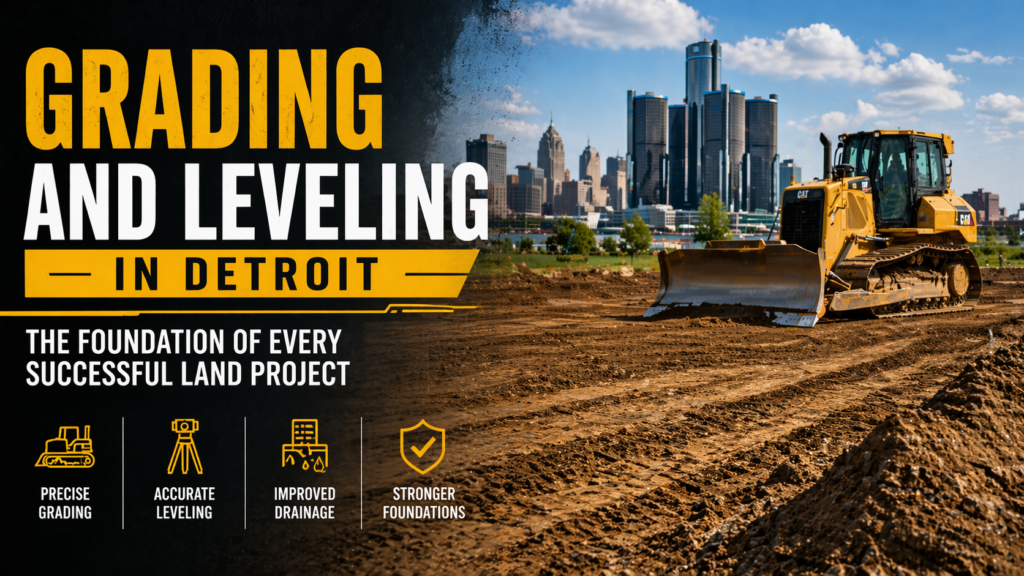
Rough grading follows the assessment phase. This is the bulk earthmoving stage, where bulldozers, motor graders, excavators, and skid steers are used to reshape the land according to the plan. Excess soil is cut from high areas and redistributed to fill low areas, a process called cut and fill. In some cases, additional fill material is brought in from off-site if the volume of available soil is insufficient.
After rough grading is complete, fine grading brings the surface to its final condition. This involves precision work using grading blades and laser-guided equipment to achieve exact slopes, smooth transitions, and the surface finish required before seeding, paving, or construction begins. Fine grading is particularly important for construction projects where proper drainage slopes must meet specific standards to protect the integrity of the building.
Key Applications of Grading and Leveling
Grading and leveling services are used across a wide range of applications in the Detroit metropolitan area.
Residential yard grading is one of the most common applications. Homeowners frequently seek grading services to correct drainage problems standing water in yards, water intrusion near foundations, and erosion grooves left by runoff are all signs that the yard’s grade needs attention. Re-grading a residential yard can transform an unusable, soggy space into a functional outdoor area while protecting the home from costly water damage.
Pre-construction grading is essential for any new building project. Whether it is a new home, an addition, a garage, or a commercial development, the building pad must be properly graded and compacted before foundation work can begin. Grading at this stage also establishes the drainage patterns that will govern the entire site for the lifetime of the structure.
Driveway and pavement grading ensures that paved surfaces drain properly and do not develop low spots where water collects, accelerating deterioration. Athletic fields, community gardens, and recreational spaces also depend on precise leveling to ensure safe and functional use.
Equipment Used in Grading and Leveling
The equipment selected for a grading project depends on the scale of the work. For large commercial projects or new subdivisions, full-size motor graders and bulldozers are the primary tools. These machines can move large volumes of soil quickly and can be equipped with GPS-guided blade control systems that allow for highly accurate grading across large areas.
For residential and smaller commercial projects, compact equipment such as skid steers, mini excavators, and compact track loaders are commonly used. These machines are maneuverable enough to work in confined spaces typical of many Detroit residential lots and can be fitted with various attachments including grading blades, box blades, and land planes to suit different stages of the grading process.
Laser leveling technology has become increasingly common in fine grading applications. Laser-guided systems allow operators to achieve consistent slopes and elevations with a degree of precision that is difficult to achieve by eye alone, particularly important when grading to specific drainage grades required by local building codes.
Grading and Drainage: A Critical Relationship
One of the primary purposes of grading is managing how water moves across and away from a property. A properly graded site directs water toward drainage systems, away from structures, and away from neighboring properties. Poor grading can cause water to pool near foundations, erode topsoil, damage landscaping, and even create liability issues if runoff affects adjacent properties.
In Detroit, where many neighborhoods have aging storm sewer infrastructure, grading plays a particularly important role in reducing the volume of water that reaches municipal systems during heavy rain events. Well-graded residential properties that guide water into appropriate drainage paths help reduce the strain on city infrastructure during peak storm events.
Permits and Regulations
In the City of Detroit and surrounding municipalities, grading projects particularly those involving significant earthmoving or changes to drainage patterns may require permits from the local building department or drainage district. The Wayne County Department of Public Services and the Southeast Michigan Council of Governments both have regulations governing how grading affects regional drainage systems.
Working with an experienced contractor who understands local requirements helps ensure that a grading project is completed in compliance with applicable codes, avoiding potential fines or mandatory corrections that can be costly after work is already done.
Final Thoughts
Grading and leveling in Detroit is a technically demanding and critically important service that underpins successful construction, landscaping, and property management projects throughout the region. By understanding the process, its applications, and why it matters in the context of Southeast Michigan’s soil and drainage conditions, property owners are better equipped to make informed decisions about their land improvement projects.